

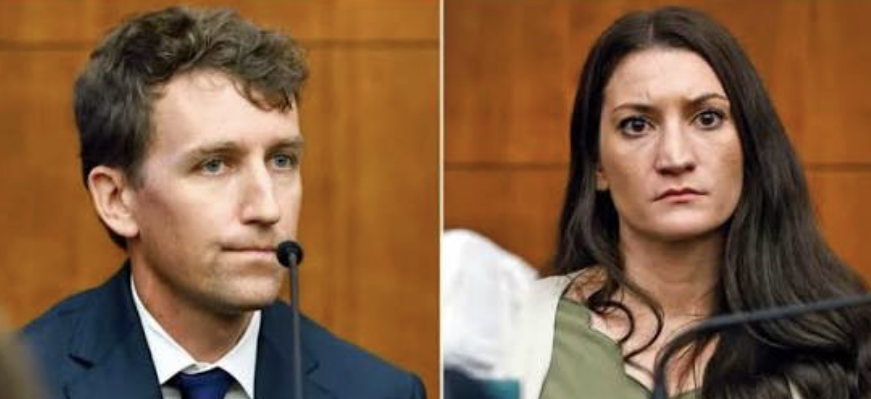
The Lindsay Clancy case has drawn enormous attention because of the deaths of three young children, the debate over postpartum psychosis, and the question of whether Clancy should be held criminally responsible. But the Lindsay Clancy conspiracy theories about her ex-husband, Patrick Clancy, have grown almost as large online as the case itself.
Lindsay Clancy has never denied causing her children’s deaths. Her defense has focused on her mental state, arguing she was in the grip of postpartum psychosis and bipolar disorder. Yet online, a different theory persists: that Patrick may have been involved, and that Lindsay is somehow protecting him.
So how did that theory take hold?
The facts versus the internet’s version
Prosecutors and the defense agree on much of what happened on January 24, 2023. Lindsay took her daughter Cora to a doctor’s appointment that morning, and the children played in the snow afterward. That evening, Patrick left the family’s Duxbury, Massachusetts home to pick up takeout. He stopped at CVS along the way for medicine Lindsay asked him to buy, a request she added after he had already left (Boston Globe; CBS Boston).
He was gone for less than an hour. When he returned, the house was unusually quiet. He found Lindsay injured outside the home, and he then found the children dead in the basement. His 911 call, which the judge barred from public release, was played for the jury and left many in the courtroom, including jurors, visibly shaken (WBUR; Boston Globe).
That timeline rests on more than Patrick’s word. Jurors saw surveillance footage of him inside the CVS and the restaurant, and they heard testimony from employees at both. Patrick also testified under direct and cross-examination (Boston Globe; Oxygen). It doesn’t answer every question about the case, but it is a documented account of where he was during the window prosecutors say the killings occurred.
None of that has stopped some online creators from treating his behavior afterward as suspicious.
Why do people suspect Patrick?
The online case against Patrick isn’t built on one piece of evidence. It’s built on a pattern of things people have decided look suspicious: his demeanor in court, his move to Manhattan, an overseas trip, a new relationship, and his remarriage before the trial concluded (The Nightly).
None of those things, on their own, establishes involvement in a crime. This is where conspiracy theories gain traction. Instead of starting with evidence and asking what it proves, people start with a theory and go looking for details that seem to fit it.
Someone sees Patrick moving away after the deaths and calls it suspicious. Someone else sees the same move as a man trying to survive an unimaginable loss. The behavior is identical, and only the interpretation changes. Much of what’s cited online as “evidence” against Patrick is behavior that has been judged, after the fact, to look guilty.
The biggest problem with the theory
The most inconvenient fact for the theory is that Lindsay’s own defense attorney has rejected it, repeatedly and on the record.
After the mistrial, Kevin Reddington initially distanced himself from the online claims without directly denouncing them, telling reporters, “I think you can judge his credibility by that 911 call” (Boston.com). He later went further. On CBS Mornings, he called on people to “stop with the speculation and horrific conspiracy allegations”. Asked directly, he said: “I’ve never said he did. I never would say he did. I don’t think the evidence shows that he did” (Fox News).
That matters because Reddington’s job is to defend Lindsay. If evidence pointed to Patrick, raising that possibility could have helped her case. Instead, the defense built its argument around Lindsay’s mental state, her medication changes, and a psychiatric crisis the healthcare system allegedly failed to catch. The theory pushed online isn’t just unsupported by the evidence presented at trial. It’s a theory Lindsay’s own lawyer has had both the opportunity and the incentive to raise, and hasn’t.
Why this case is so easy to turn into a conspiracy
Part of the answer is that the real explanation is genuinely hard to sit with. There is no simple motive that makes a mother killing her own children comprehensible. The defense’s account involves postpartum psychosis, escalating medication, and command hallucinations. The prosecution’s account involves planning and criminal responsibility.
Neither gives an audience the tidy story true crime usually offers, because there is no whodunit here. The person who caused the deaths is known, and the open question is what was happening in her mind and whether that changes her culpability. For some people, that ambiguity is harder to accept than a story with a different villain. Researchers who study conspiracy thinking say something similar: people who follow a case closely but distrust the institutions handling it are more likely to adopt alternative explanations (CNN).
True crime audiences are also trained to think like investigators, parsing timelines, messages, and courtroom testimony. That instinct isn’t inherently bad, and public scrutiny has uncovered real mistakes in other cases. But there’s a difference between asking questions and treating an unanswered question as proof.
In the Clancy case, that line dissolved fast. A facial expression became evidence. A move to a new city became evidence. A second marriage became evidence. Ordinary post-tragedy behavior was reframed as “consciousness of guilt,” a legal term for conduct that suggests someone knows they’ve done something wrong.
The mistrial gave the theories more oxygen
The speculation intensified after the jury deadlocked. Following nearly 40 hours of deliberation over seven days, Judge William Sullivan declared a mistrial on September 4, 2026 (ABC News).
The case remains unresolved. At a status hearing on September 29, no retrial date was set, and several motions were pushed to a hearing scheduled for November 2. Those include a defense motion to dismiss the case on double jeopardy grounds (CNN).
A mistrial isn’t an acquittal or a conviction. It’s an unresolved outcome, and unresolved outcomes are exactly the kind of gap the internet tends to fill with its own explanations.
When skepticism becomes something else
It’s entirely reasonable to question how the healthcare system handled Lindsay’s care. She had sought psychiatric treatment for months before the killings, was cycled through multiple medications, reported hallucinations and suicidal thoughts, and had been hospitalized weeks earlier. Both Lindsay and Patrick have since filed separate malpractice and wrongful-death suits against the medical providers involved. Lindsay’s suit alleges a “catastrophic failure” to properly diagnose and treat her. The providers deny the allegations and have asked the court to dismiss Patrick’s suit (NewsNation). Those suits are pending, and the allegations in them haven’t been adjudicated. Still, they’re a legitimate, documented basis for asking hard questions about her care.
That’s a fundamentally different question from “Patrick must have been involved.” One is scrutiny of a documented healthcare failure. The other is an accusation against a specific person that, so far, no evidence presented in court supports, and it hasn’t stayed harmless. Patrick’s attorney, Howard Cooper, has publicly accused online commentators of running a “relentless, escalating and destructive defamation campaign” that has produced real threats to Patrick’s “reputation, livelihood, and life.” He has also threatened legal action against those spreading the claims (Boston.com).
What this case tells us about true crime
The Lindsay Clancy case isn’t just a murder trial or a debate over postpartum psychosis. It’s a case study in how the internet handles uncertainty. Documented facts, disputed interpretations, civil allegations, expert testimony, and pure speculation all exist here at once, and online they tend to blur together. A single clip from a nearly six-week trial gets presented as if it explains the whole case. A comment section turns a question into an accusation. Once enough people repeat it, it starts to feel like an established fact, even though nothing underneath it has changed.
There’s no judge in that version of the courtroom to separate evidence from speculation. That job falls to the audience, and to the creators building a following on the story. The unanswered questions in this case are real, but an unanswered question isn’t evidence of a conspiracy.
Behind every headline and hot take are three children, Cora, Dawson, and Callan, and the families who lost them. As the case heads toward its next hearing, that is worth remembering, along with the distinction between what we know and what we only suspect.

