

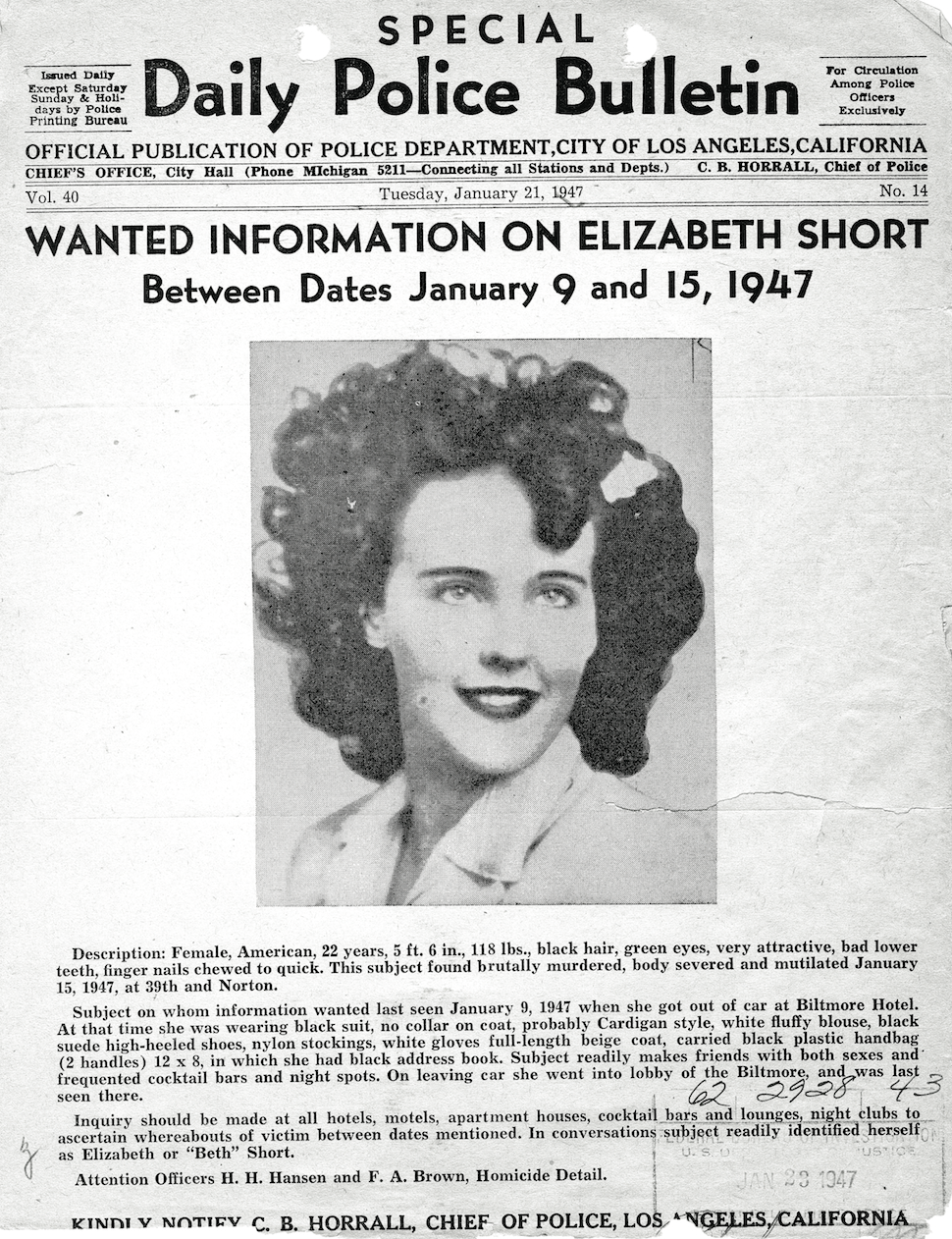

On January 15, 1947, the body of 22-year-old Elizabeth Short was discovered in a vacant lot in Los Angeles. Within days, newspapers had given her a nickname that would outlive her real one: “The Black Dahlia.” Nearly eight decades later, her murder remains unsolved. The case has inspired books, films, conspiracy theories, and countless amateur investigations. But beneath the mythology is a core of documented fact — a young woman, a brutal crime, a massive investigation, and no conviction. The post deep dives into Shorts life; her dreams of making it big in Hollywood and how that was ripped away from her at just 22-years old.
Who Was Elizabeth Short?
Elizabeth Short was born on July 29, 1924, in Boston, Massachusetts. She spent portions of her youth in both Massachusetts and Florida. Like many young people in the 1940s, she was drawn to Southern California during and after World War II. It is often repeated that she was an “aspiring actress.” Friends and acquaintances described her as outgoing and sociable. She moved frequently, staying with acquaintances and in short-term arrangements. That transient lifestyle has contributed to confusion in reconstructing her final days. Elizabeth Short was a real person whose identity was gradually overshadowed by a sensational nickname.
January 15, 1947: The Discovery
On the morning of January 15, 1947, Short’s body was found in a vacant lot in the Leimert Park neighborhood of Los Angeles. The condition of the body shocked investigators and the public alike. Authorities determined she had been killed elsewhere and transported to the lot. The positioning of the body and the nature of the injuries became a major factor in media coverage and speculation about the killer’s possible background. The Los Angeles Police Department took the lead in the investigation, with assistance from the Federal Bureau of Investigation in areas such as fingerprint comparison and interstate record checks. The crime scene quickly drew reporters. Within days, headlines across the country amplified the horror of the case.
How the Name “Black Dahlia” Took Hold
The nickname “Black Dahlia” was coined by the press shortly after the murder. It is widely believed to have been inspired by the 1946 film The Blue Dahlia and reports that Short sometimes wore black clothing. There is no evidence that Elizabeth Short called herself this nickname. It was a media creation. This branding had consequences. The name was mysterious, dramatic, and marketable. It helped transform a murder investigation into a cultural phenomenon. The more it was printed, the more it replaced her actual identity in public memory.
The Early Investigation
The Los Angeles Police Department launched an enormous investigation. Thousands of tips poured in. Detectives interviewed acquaintances, former romantic partners, and anyone believed to have crossed paths with Short in the weeks before her death. Because of the precision of certain injuries, investigators explored whether the killer might have had medical or anatomical training. At one point, records checks were conducted involving students at the University of Southern California medical school. It’s critical to clarify: exploring a medical angle does not confirm the killer was a doctor or medical student. It was one investigative theory among many. The FBI assisted by checking fingerprints and running background searches on suspects identified by LAPD. Fingerprints taken from an anonymous letter connected to the case were compared against federal databases, but no match was found at the time.
Anonymous Letters and Public Frenzy
Shortly after the murder, newspapers and police reportedly received communications from someone claiming knowledge of the crime. Some letters included personal items believed to belong to Short. The FBI analyzed fingerprints from at least one anonymous letter, but records indicate no conclusive identification resulted from that evidence. Meanwhile, the media frenzy intensified. Reporters often contacted Short’s family under false pretenses to obtain information and photographs before informing them of her death. This aggressive coverage further blurred the line between investigation and spectacle.
The overwhelming publicity created two major problems:
- False confessions increased.
- Genuine leads became harder to separate from noise.
Suspects Over the Years
The Black Dahlia case has seen dozens — possibly hundreds — of persons of interest over time. However, no one was ever charged.One of the most widely discussed suspects decades later was George Hodel, a Los Angeles physician. Hodel became the focus of renewed attention after his son, a former LAPD detective, publicly argued that his father was responsible. The theory gained significant media traction, but it has never resulted in formal charges or prosecutorial findings. As with many high-profile cold cases, compelling narratives and circumstantial interpretations do not equate to legal proof. Other suspects have surfaced periodically through books, documentaries, and amateur research, but none have led to resolution.
Timeline Challenges
One of the biggest obstacles in the case is reconstructing Elizabeth Short’s final movements with certainty. Various accounts suggest she was last seen at different locations in Los Angeles, including the Biltmore Hotel. However, documentation from 1947 contains inconsistencies, and witness memories were filtered through intense media coverage. When a case becomes famous immediately, public retellings can reshape details. Over time, repeated versions of events can harden into “facts” even when primary documentation is less clear.
Historians examining archived newspaper articles and police summaries have noted contradictions in:
- Where she stayed in her final week
- Who last saw her
- Exact dates and times of sightings
The lack of a clean, uncontested timeline is one reason the case remains vulnerable to reinterpretation.
Forensic Limitations of 1947
Modern audiences often ask: why wasn’t this solved with evidence? In 1947, forensic science was limited compared to today’s standards. DNA profiling did not exist. Fingerprint comparison required manual processes. Crime scene preservation protocols were not as standardized as they are now. If usable biological evidence was collected, its condition today would determine whether advanced testing could be conducted. Chain of custody, contamination, and storage practices all influence whether cold cases can be reopened successfully. While some cold cases from the mid-20th century have been solved using modern DNA analysis, it depends entirely on whether viable evidence remains.
Media, Myth, and Cultural Impact
The Black Dahlia case became embedded in American crime lore. It influenced novels, films, and the broader aesthetic of Los Angeles noir storytelling. The case is frequently cited alongside other infamous unsolved murders, contributing to a perception of postwar Los Angeles as glamorous yet dangerous. However, cultural fascination has often overshadowed the victim. Over decades, portrayals have at times suggested salacious or exaggerated elements of Short’s lifestyle. Contemporary researchers emphasize the importance of grounding the story in documented evidence rather than rumor. The more sensational the narrative becomes, the further it drifts from the historical record.
Why the Case Remains Unsolved
Several factors likely contributed:
- High volume of tips: Investigators were inundated, making it difficult to prioritize credible leads.
- Publicity interference: Media coverage may have compromised witness reliability.
- Forensic constraints: Limited technology restricted evidence analysis.
- Time: As years passed, witnesses died and memories faded.
Cold cases grow harder to solve as decades pass unless preserved evidence can be reexamined with new methods.
Modern Reassessment
Over the years, journalists and historians have revisited original files to separate fact from embellishment. Efforts have been made to:
- Reexamine archived LAPD and FBI documents
- Compare contemporary newspaper accounts with later retellings
- Evaluate suspect theories against primary evidence
Despite renewed interest, no official resolution has been announced. The case remains open in the sense that it was never formally closed with a conviction, but practical limitations may prevent definitive answers.
Common Myths vs. Documented Reality
Myth: The killer was definitely a surgeon.
Reality: Investigators considered medical knowledge as one possibility. No conclusive evidence proved that theory.
Myth: The case has been secretly solved.
Reality: No law enforcement agency has announced a verified solution.
Myth: Elizabeth Short lived a dramatic double life.
Reality: Many sensational claims stem from speculative reporting rather than official records.
Distinguishing between narrative drama and documented fact is essential when discussing this case.
The Human Element
Amid analysis, suspects, and cultural legacy, it’s easy to lose sight of the central truth: Elizabeth Short was a 22-year-old woman whose life ended violently and prematurely. True crime storytelling often emphasizes mystery and horror, but responsible retelling requires centering the victim rather than the mythology. Her murder remains one of the most widely discussed unsolved cases in American history, not only because of its brutality, but because it intersects with Hollywood imagery, media power, and the psychology of public obsession.
Could It Be Solved Today?
In theory, yes — if preserved evidence exists in usable condition. Advances in DNA analysis, forensic genealogy, and digital archival comparison have reopened other mid-20th-century cases.
In practice, the feasibility depends entirely on:
- Whether biological samples were properly stored
- Whether contamination occurred
- Whether suspect comparison DNA is available
Without viable evidence, modern technology cannot retroactively create proof.
Why the Black Dahlia Case Endures
The endurance of this case comes from a convergence of factors:
- Postwar Los Angeles mystique
- Striking media branding
- Brutal circumstances
- An unresolved ending
Unsolved cases invite speculation. When a crime intersects with fame and imagery, speculation multiplies. But longevity does not equal clarity.
Final Thoughts
The Black Dahlia case remains one of America’s most famous unsolved murders. What we can say with certainty is limited:
- Elizabeth Short was killed in Los Angeles in January 1947.
- The LAPD led a massive investigation with FBI assistance.
- Numerous suspects were considered.
- No one was charged.
Everything beyond that must be evaluated carefully, distinguishing between primary documentation and later storytelling. In a world saturated with dramatic retellings, the most responsible approach is also the simplest: state what is verified, acknowledge what is unknown, and resist turning a real person into a legend detached from reality. The mystery persists. The myths persist. But the facts; sparse, documented, and incomplete, remain the foundation of the Black Dahlia case.
To read more about Elizabeth Short, read this blog post also found on uatwitch.com;
To learn more about the case visit https://www.fbi.gov/history/famous-cases/black-dahlia and https://www.novelsuspects.com/articles/a-brief-history-of-the-black-dahlia/

